
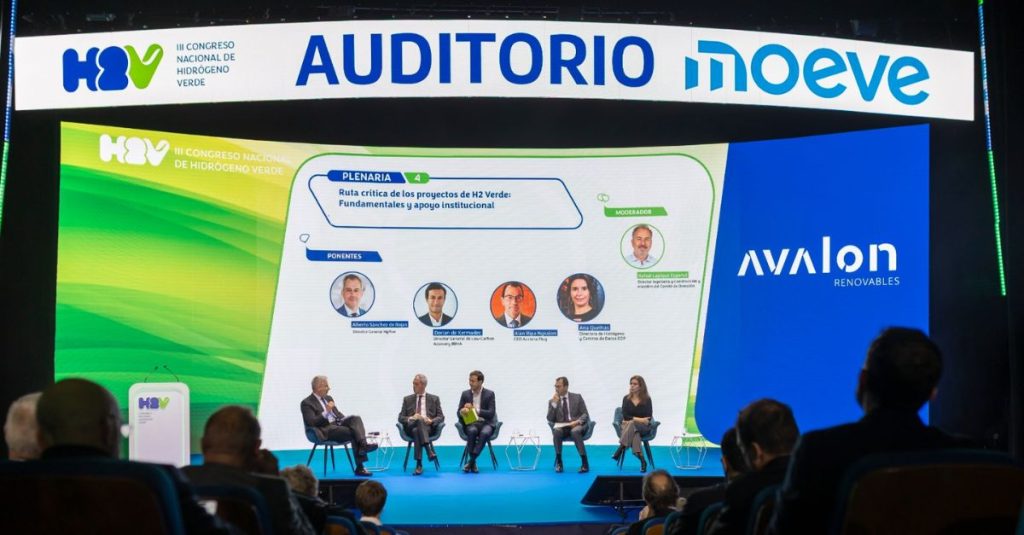
From February 4–6, 2026, the III National Green Hydrogen Congress reaffirmed its position in Huelva as Spain’s leading technical and strategic forum for advancing renewable hydrogen and its associated industries. The event brought together more than 1,400 participants, over 450 companies, and upwards of 80 high-level national and international speakers.
The Current State of Green Hydrogen in Spain
Green hydrogen, produced through water electrolysis powered exclusively by renewable energy, has emerged as a critical energy vector in Europe’s and Spain’s industrial decarbonization, mobility, and chemical-energy strategies. Its development aligns with national and European goals to reduce emissions, diversify energy sources, and build new technological and industrial value chains.
In Spain, 2030 electrolyzer capacity targets have recently been reinforced under the National Integrated Energy and Climate Plan (PNIEC), setting ambitious goals to install 12 GW of electrolysis capacity dedicated to renewable hydrogen production. This underscores the country’s clear intention to position itself as a leader in this strategic sector.
A Practical Roadmap Toward Bankable Projects
One of the most significant technical consensuses emerging from the Congress was the urgent need to transition from announced projects to fully executed ones. Industry experts and key stakeholders emphasized:
- The need for a more realistic and actionable national roadmap, including regulatory measures, financing mechanisms, and administrative coordination to accelerate industrial deployment.
- The consolidation of a “critical path” integrating safety requirements, harmonized regulatory frameworks, and a reliable demand chain capable of converting investment momentum into operational assets.
- The importance of stable regulatory frameworks to reduce uncertainty and enable long-term investment planning.
This practical approach directly addresses a shared industry challenge: narrowing the gap between ambition and the real-world execution of infrastructure, production plants, logistics systems, and end-use applications for green hydrogen.
Technical Focus on Hydrogen Derivatives and Synthetic Fuels
Beyond hydrogen itself, the Congress placed strong emphasis on high-potential derivative products:
- Green methanol: A strategic chemical vector facilitating hydrogen use in the chemical industry, maritime transport, and other high-energy-demand sectors.
- Green ammonia: A key hydrogen carrier for export and fertilizer applications, supported by an already well-established global market.
- Synthetic biofuels and SAF (Sustainable Aviation Fuels): High-interest segments for decarbonizing hard-to-electrify sectors such as aviation and heavy transport.
Focusing on derivatives responds to the need to expand concrete industrial use cases capable of absorbing renewable hydrogen production and creating fully integrated value chains, from energy supply to end-use applications and global markets.
Collaboration, Investment, and Sector Integration
Hosting the Congress in Huelva facilitated direct engagement among companies, institutions, and investment funds, enabling organizations to:
- Connect with sector investors, specialized funds, and energy and financial market players.
- Explore synergies across the hydrogen and renewable energy value chains.
- Initiate discussions on business models and industrial integration strategies.
Beyond its national scope, the Congress highlighted that green hydrogen development is already operating at a global scale, reinforced by participation from European, Latin American, and Asian delegations and companies.
In this context, Cubicoff participated actively with its own technical presentation and exhibition stand. This presence not only strengthened the company’s positioning among a specialized audience but also fostered dialogue with potential investors and strategic partners worldwide.
From a technical and industrial standpoint, Cubicoff delivers highly specialized, end-to-end industrial engineering and architectural solutions for the development of green hydrogen plants and related components, including:
- Engineering for electrolyzer manufacturing facilities across multiple technologies (PEM, alkaline, STACK components, and complete systems).
- Design of laboratories and testing centers for cell and production system development and validation.
- Advanced industrial architecture for production facilities within the green hydrogen (H2V) value chain and its derivatives.
This combination of capabilities positions Cubicoff as a trusted partner for technically complex projects, translating sustainability and decarbonization strategies into tangible industrial infrastructure.
Conclusion: Entering the Industrial Consolidation Phase
The III National Green Hydrogen Congress marks a turning point. The sector is evolving into a phase where the priority is no longer announcing projects, but executing them with technical rigor, financial solidity, and a long-term industrial vision.
Spain has the natural resources, industrial ecosystem, and strategic positioning required. The challenge now lies in aligning regulation, infrastructure, and investment to transform potential into effective production capacity.
In this context, specialized industrial engineering firms such as Cubicoff play a critical role in converting energy strategy into facilities, factories, and tangible assets that drive the transition toward a decarbonized economy.