
Advanced design, simulation and artificial intelligence to drive innovation in metal additive manufacturing.
Cubicoff continues to make progress on METALIA, an R&D project focused on developing new solutions to improve metal additive manufacturing through advanced design, simulation and artificial intelligence tools.
Additive manufacturing, commonly known as 3D printing, enables components to be produced by building up material layer by layer. This technology opens up new possibilities for creating complex geometries that would be extremely difficult, or even impossible, to achieve using conventional manufacturing methods.
METALIA explores how these capabilities can be applied throughout the entire component development process, from geometric design and performance simulation to manufacturing and the subsequent validation of results.
Cubicoff’s role in METALIA
As part of the project, Cubicoff is working on the development and optimisation of advanced geometries specifically designed for additive manufacturing.
Our contribution combines advanced geometric design, mechanical and computational fluid dynamics (CFD) simulation, analysis of the printing process and validation, with the aim of transforming an initial geometry into an optimised design ready for manufacturing.
This work follows an iterative process:
Design → Simulation → Analysis → Redesign → Validation
This approach allows different design alternatives to be evaluated virtually before components are physically manufactured, reducing uncertainty during development and supporting better-informed design decisions.
Heat exchangers with TPMS structures
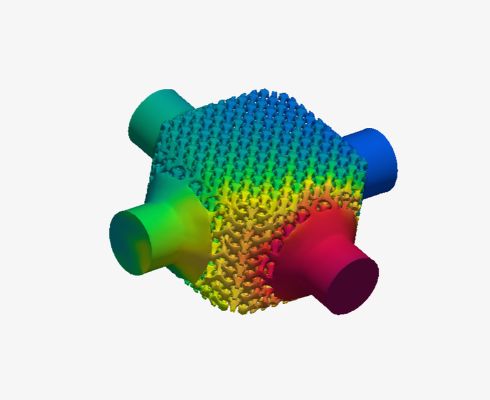
One of Cubicoff’s research activities within METALIA focuses on designing heat exchangers incorporating internal triply periodic minimal surface (TPMS) structures.
These structures feature highly complex, continuous three-dimensional geometries that provide a large heat transfer surface area within a compact volume. Integrating them into a heat exchanger also changes the flow paths of the fluids, creating new opportunities to optimise the component’s thermal performance.
For the demonstrator developed as part of the project, Cubicoff starts with the heat exchanger’s basic geometry and incorporates a TPMS structure tailored to its internal volume. The design is then evaluated using computational fluid dynamics (CFD) simulations to study fluid flow within the component and analyse the heat transfer process.
The model examines the behaviour of two working fluids — oil as the hot fluid and water as the cold fluid — allowing temperature distribution to be visualised, thermal gradients to be identified and the influence of the internal geometry on heat transfer to be assessed.
Simulating before manufacturing
Simulation plays a central role in this process. Before manufacturing the demonstrator, Cubicoff can compare different configurations, analyse fluid flow and heat transfer behaviour, and identify potential design improvements.
The work goes beyond assessing how the component performs during operation. Cubicoff also investigates the additive manufacturing process itself, examining factors such as part orientation, support structures, and potential deformation and residual stresses generated during printing.
By bringing together design, engineering analysis, simulation and manufacturing within a single workflow, the project aims to enable the development of complex metal components with greater efficiency and control.
Through its participation in METALIA, Cubicoff continues to strengthen its research, development and innovation (R&D&I) activities in industrial engineering, combining advanced design, simulation and additive manufacturing to explore new solutions and translate them into real-world industrial applications.
The project is funded by the Centre for the Development of Industrial Technology (CDTI) and the Spanish State Research Agency (AEI).